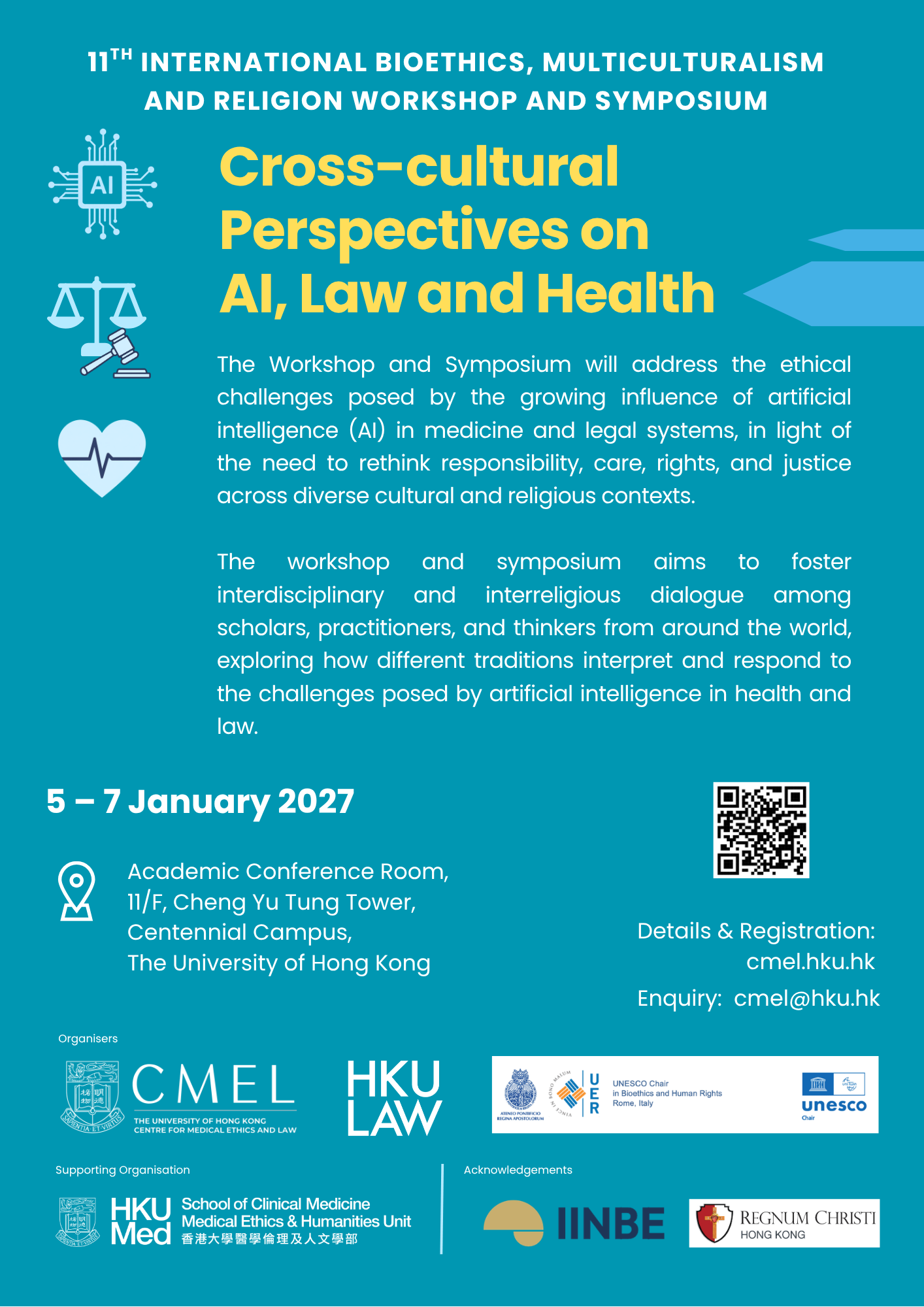




The 11th International Bioethics, Multiculturalism and Religion Workshop and Symposium will address the ethical challenges posed by the growing influence of artificial intelligence (AI) in medicine and legal systems, in light of the need to rethink responsibility, care, rights, and justice across diverse cultural and religious contexts.
The workshop and symposium aims to foster interdisciplinary and interreligious dialogue among scholars, practitioners, and thinkers from around the world, exploring how different traditions interpret and respond to the challenges posed by AI in health and law.
Speakers List: click here
Methodology: click here
Schedule: click here
Workshop Organization Structure: click here
Registration: click here
Co-organisers:
Centre for Medical Ethics and Law (CMEL), The University of Hong Kong
UNESCO Chair in Bioethics and Human Rights
Supporting organisation:
Medical Ethics and Humanities Unit (MEHU), The University of Hong Kong
More information about the Workshop and Symposium:
AI is reshaping healthcare, legal systems, and human society at an unprecedented pace. As these technologies continue to evolve, they raise profound ethical, legal, cultural, and religious questions that require dialogue across disciplines and traditions.
The 11th International Bioethics, Multiculturalism and Religion Workshop and Symposium brings together internationally recognized scholars, healthcare professionals, legal experts, philosophers, theologians, and policymakers to examine these challenges through the shared framework of global bioethics and human rights.
During the three days of our UNESCO Chair workshop, we will analyze and discuss “Cross-cultural Perspectives on AI, Law, and Health”. The study and conversations will focus on how different traditions understand the discipline of medicine and perceive the practitioners of the discipline. Previous workshops have successfully taken place in Rome, Hong Kong, Mexico, Houston, Casablanca, Bangkok, and Madrid with the participation of more than 80 prestigious interdisciplinary scholars from around the world.
Key Questions:
AI and Human Identity
- AI as assistants vs. autonomous agents. In what way would they be free or autonomous?
- What does it mean to be self-aware or conscious (for humans and AI)?
- What kinds of perceptions would super-intelligent AI have compared to animals and humans?
- What does it mean for AI to have personhood, culpability, guilt, regret, forgiveness, and even faith—if possible?
- What are the implications for religious traditions, and what resources could they bring to the discussion?
AI in Healthcare
- Is it desirable for AI robotics to substitute the human touch, or is the goal instead to use AI to complement the healthcare profession?
- Who is responsible (the moral agent) when AI is used to support decision-making?
- What might be the potential effects on people’s trust, sense of dignity, and social isolation in care situations?
- How would it affect the roles and skill requirements of healthcare professionals?
- What is the impact of the human-machine relationship in terms of the reductionism of the human touch to something inhuman?
Human Rights, Law, and Justice
- To what extent might religious ethics and human rights defend anonymity/privacy in employment, education, health insurance, and equal access?
Workshop Methodology
The workshop follows a distinctive collaborative academic model designed to encourage genuine dialogue rather than isolated presentations.
Invited scholars prepare original papers addressing the workshop’s leading questions from the perspective of their own religious or cultural tradition. Each paper is assigned to another international expert who prepares a scholarly response, encouraging constructive discussion and deeper understanding.
During the three-day workshop, authors present concise summaries of their work, followed by extensive dialogue, questions, and interdisciplinary exchange. Following the workshop, contributors revise their papers in light of the discussions before publication in an edited academic volume.
This process creates lasting scholarly collaboration and advances the UNESCO Chair’s mission of fostering convergence and cooperation in global ethics.